Posts

Przemysl, 1939

Image
19 December, 1939 Przemysl, Poland On September 14, 1939, the town of Przemysl was occupied by the German army. The town was home to 24,000 Jews. ( Yad Vashem ) Although control of the city was later transferred to the Soviets, the Germans made sure to first attack the Jews of the community. They burnt down the Old Synagogue, the Klois, the Hassidic prayer house, the Tempel Synagogue and parts of the Jewish quarter. ( Holocaust Research Project ) According to a  JTA  report, a few months later the Nazis locked 30 Jews into their synagogue and burnt it to the ground. This was reported on the basis of "Polish sources." However, neither Yad Vashem nor the Przemysl Yizkor Book make any mention of Jews being killed in the synagogue. They instead mention only the burning of the synagogues in September 1939. It could be that the report in December actually refers to the events of September, or perhaps the Polish papers were trying to rally support against the Nazis but r...
The Crusades in Mainz, 1096

Mainz 1096 Mainz was one of the three major European Jewish communities that was destroyed during the First Crusade. The community's fate was chronicled by Shlomo ben Shimon a generation after it occurred. Among the many accounts, he tells of Yitzchak the Hassid, who survived the initial wave of attacks by converting, but then had remorse. He decided that in order to atone he had to give himself up and die sanctifying the name of God. Yitzchak tells his mother "I have decided to bring a sin offering to God." He takes his son and daughter to the synagogue, stands before the Ark and cuts their throats. As he watches their blood spurt onto the ark he cries out "Let there blood be an atonement for my sins!" He returns home, burns his house down (with his mother inside), then returns to the synagogue and does the same, beseeching God from within the flames. Another Jew, Ori, decides to join him in the flames, and the two perish. The synagogue is saved from...

Why Seek Refuge in a Synagogue?

To be analytical about a very emotional subject, the different cases of synagogue massacres can be groups into several categories: Jews are attacked in a synagogue during a regular service. This  is (thankfully?) the only situation that still takes place post-Holocaust.  Jews are forced to gather in the synagogue and then executed Jews flee to the synagogue for refuge and are nonetheless overrun. Group 3 seems the most curious situation. Despite generations of stories, despite the chance to chose a low-key hiding spot, Jews have persisted in running to the synagogue for protection. Why is this so? I have a few suggestions: The synagogue truly provided a good refuge The synagogue was generally a better-constructed building than most residential hovels, and could be better defended.  The synagogues of some towns were made of stone and were thus more fire-resistant.  The synagogue was a convenient place of congregation Jews could potentially organize a...

Siege of Acre, 1291

Image
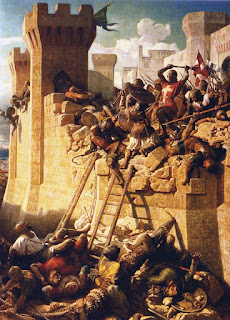
Acre 28 May 1291 During the 12th and 13th centuries, control of Israel passed from the Crusaders to Saladin back to the Crusaders and to the Mamluks. Saladin conquered Acre in 1187. It was retaken by Christian knights of the Third Crusade in 1191  The city was attacked but not conquered in 1263. In 1291 the Mamluks besieged Acre. The siege lasted a month and a half. On May 18, 1291 the Mamluk troops broke through and captured the city. They pillaged and destroyed the city, saving only Muslim holy shrines. During this attack the city's small Jewish community was destroyed. At the time, the Acre was a regional center of Jewish learning. People from other communities would send halachic questions to the sages of the city. (Jonathan Rubin, Intellectual Activity and Intercultural Exchanges in Frankish Acre, 1191-1291 , p37-43) A Beit Midrash was set up by R. Yechiel of Paris, known as the Great Academy of Paris , and the Jewish community thrived. All this ended when the Mamluks...

Zelechow, 1939

Zelechow, Poland 13 September 1939 The Nazis entered Zelechow on September 12, 1939. They immediately set fire to a number of buildings. The following day, the synagogue was torched and a member of the town council, Hayyim Palhendler, was trapped inside. ( Pinkas Hakehillot ) Godl Nachtajler recalls that the rest of the Jews were evacuated from the synagogue first: "The Germans cast out everyone from the synagogue, leaving only one old Jew, in order to burn him later together with the synagogue." Mendel Korcarz recalled that the fire took place on the second day of Rosh Hashana: "On the second day of Rosh Hashana they set our big and beautiful synagogue on fire. A black smoke rose from the burning Torah scrolls straight to heaven. In the town of Zelechow there was darkness." Once the synagogue was destroyed, the Jews had nowhere to pray on Yom Kippur. Again, Nachtajler recalls: "On Yom Kippur they made minyanim in different houses and prayer quiet...

Sinzig, 1266

12 April 1266 Sinzig, Germany Previously  I wrote about the Nuremberg Memorbuch, which was used to record Jewish tragedies and loss of life. Names of the dead recorded in the book were read in the synagogue at various points during the year. Most entries in the book have a very  brief, one line introduction, giving the place, date and possibly the time of year when the names of the dead should be read in synagogue. The introduction is followed be a list of those killed. So for example, one entry reads: "The dead of Erfurt, 25 Sivan 4981 [1221], including...." Occasionally, the entry will be slightly more descriptive. In all, there are two cases in which the entry specifically mentions that the people were killed in a synagogue. The Jewish community of Sinzig was attacked on Shabbat, April 12 1266. The synagogue was set on fire and 64 Jews are listed by name as having been killed in the flames. This included some of the leaders of the community. The pogrom was in pa...

Paris Bombing, 1980

Image
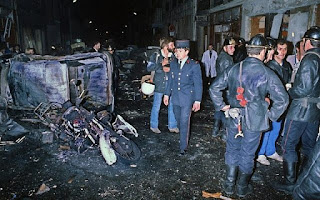
Paris, France 3 October 1980 At the beginning of Shabbat, which coincided with the holiday of Simchat Torah, the Copernic Street synagogue was filled with Jews who had come for the prayer service. There were many guests present for three bar mitzvas and two bat mitzvas that were taking place that weekend. Outside, a motorcycle packed with 10 kg of explosives was parked. At 6:38 pm, the bomb detonated. The front door of the building was blown inward. The synagogue had a glass roof, which collapsed on the people inside causing many injuries. However, the four people who were killed in the attack were all outside the synagogue. "One of the dead was identified as Aliza Shagrir, 42, an Israeli film editor who was in Paris for a two-week holiday with her 17-year-old son. She was walking to the home of a friend to meet her husband when the bomb exploded. She died on the way to the hospital. A 14-year-old girl driving a moped had the skin of her face peeled off. An elderly woman h...